Commercial · Centre Wellington
Access Control Installation
Something went missing from the storeroom over a weekend, and when you ask who was in the building, the honest answer is anyone with a key.
In plain words
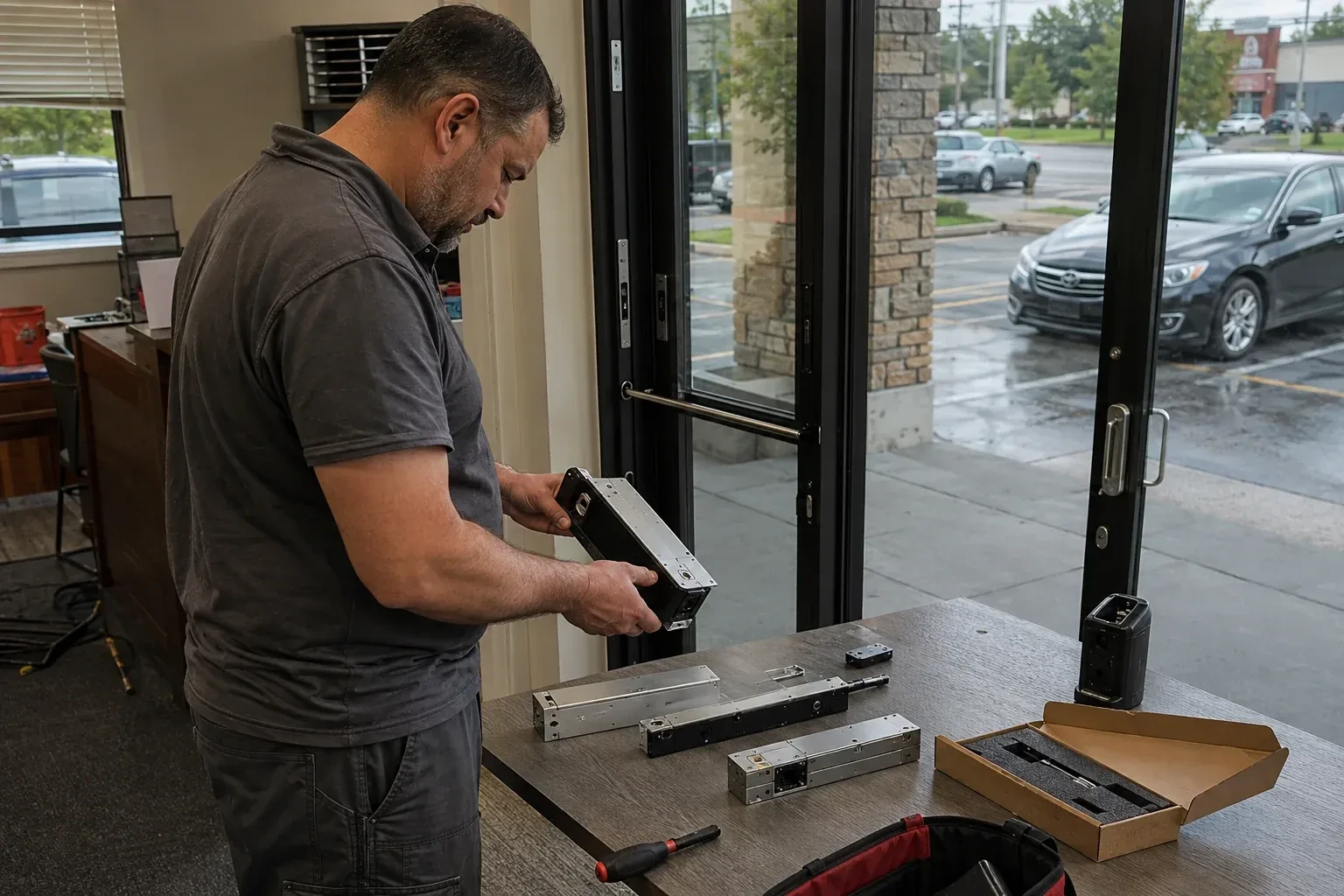
An exit door does not stop being an exit once it is wired into an access control system. A magnetic lock on that route is paired with a request-to-exit device so anyone leaving is never held up looking for a code, and it is tied into the fire alarm so an alarm signal releases the door on its own. The installation is planned around the building's exits from the start rather than added around them afterward, so the system controls who comes in without complicating how people get out.
How the visit goesAnother employee left and the keys never came back. You changed the locks again, cut copies for everyone who stayed, and paid for a job that repeats itself the next time someone quits, taking a working key out the door with them.
Access Control Installation
How the visit goes

Power, cabling, and where the controller will live
An access control system needs somewhere for its low-voltage wiring to run and somewhere secure for the controller and its power supply to sit, away from public reach. The survey traces a path from each opening back to that location, checks whether existing conduit or cable trays can be reused, and confirms what power is already available against what a new circuit or a battery backup needs to supply. A building with exposed ceilings or accessible risers is a simpler pull than one with finished walls throughout, and that difference shapes how the installation is sequenced.
Wiring the openings back to a controller
Each controlled opening can send and receive several signals: a reader reporting a presented credential, a lock output that releases the hardware, and, where the configuration calls for them, a door position switch reporting open or closed and a request-to-exit input. The locksmith runs the wiring from each opening back to wherever the controller is mounted — as a home run, along a shared bus, or over the network on an IP or PoE device — labels each conductor at both ends, and terminates them into the controller's input and output boards. A building with several openings may share one power supply and battery backup sized to the combined load, or split the load across more than one supply.
Adding a door later without starting over
A system sized with room to grow makes adding another opening later a straightforward extension rather than a second project: a new reader and lock on an added door, wired back to the existing controller where there is capacity, or a new standalone unit where the door sits far from the rest. Because schedules, access levels and credentials already exist for the rest of the building, the new door usually needs only to be slotted into that structure rather than have all of it worked out again from the beginning.
Access Control Installation
In the van
Low-voltage cable
Card and fob readers
Fire alarm interface relay
Magnetic locks
Door position switches
Access Control Installation
What affects the quote
Network readiness for a networked system
A networked controller needs a suitable connection point and technology-department approval to join the building's network; where that is not already in place, preparing it is a separate piece of the job from the door hardware itself.
How much door and frame preparation is needed
A frame that already suits an electric strike needs less preparation than one that must be mortised, reinforced, or matched with a different strike body, and an older or non-standard door can add its own preparation.
Room left for future doors
Sizing the controller and power supply with some spare capacity for a door or two added later costs a little more at installation but avoids a second controller purchase when the building later adds an opening.
What to have ready
- Do any doors need different hours than the rest of the building?
- Is there network access near where a controller could be mounted?
- Do you expect to add more controlled doors later on?
Access Control Installation: questions
QuestionsWho keeps administrative control of the software after installation?
The business does. Handover includes a full administrator account with the ability to add and revoke credentials, change schedules, and pull an entry log, confirmed working before the locksmith leaves. Whether the installer keeps any support or portal access beyond that is a setting agreed with the business, not a fixed feature of every system, so it is worth confirming as part of that handover.
Can access control go on a fire exit or a required exit door?
Yes, with extra care taken specifically because it is an exit. A magnetic lock on an exit door is paired with a request-to-exit device and wired into the fire alarm system so it releases automatically the instant an alarm activates, and the door is confirmed to open with one motion from the inside at all times. An electric strike on an exit door generally needs no additional egress hardware.
What credential types are available: cards, codes, fobs, phones?
A proximity card or fob held near a reader, a code typed on a keypad, or a mobile credential read from a phone are all in common use, and a single building can mix them by door or by person. Cards and fobs are simple to issue and switch off individually; a keypad needs no card to lose but a shared code eventually gets passed around; a mobile credential ties entry to a device the person already carries.
Related services
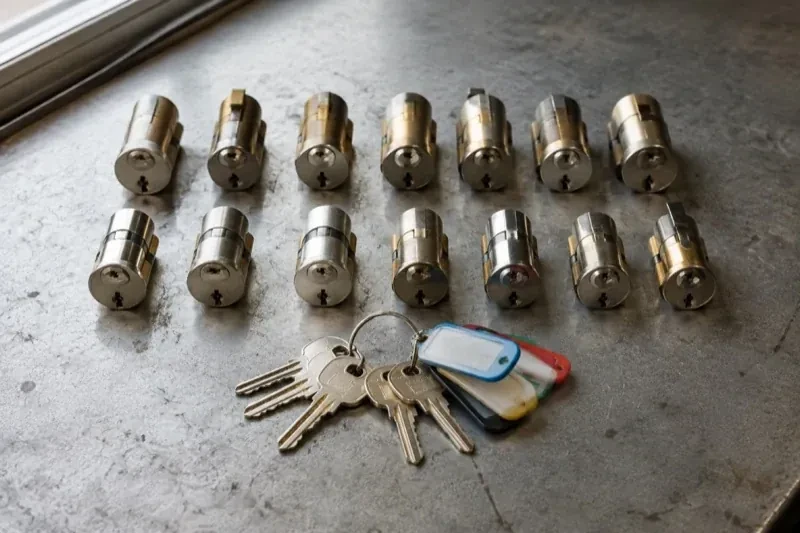
- Master Key System DesignThe office key ring has become the org chart.
- Panic & Exit HardwareTwo doors used to swing as a pair at the community hall entrance, but one leaf has started closing before the other, catching the astragal and leaving a gap wide enough to worry the caretaker.
- Commercial-Grade Lock ReplacementA new tenant moved into the unit next door, and the property manager just found three different cylinders on three doors, none of them cut to the same key.