Lockouts · Centre Wellington
Business Lockout Service
The key went in stiffly, turned a quarter of the way, and came out in two pieces.
In plain words
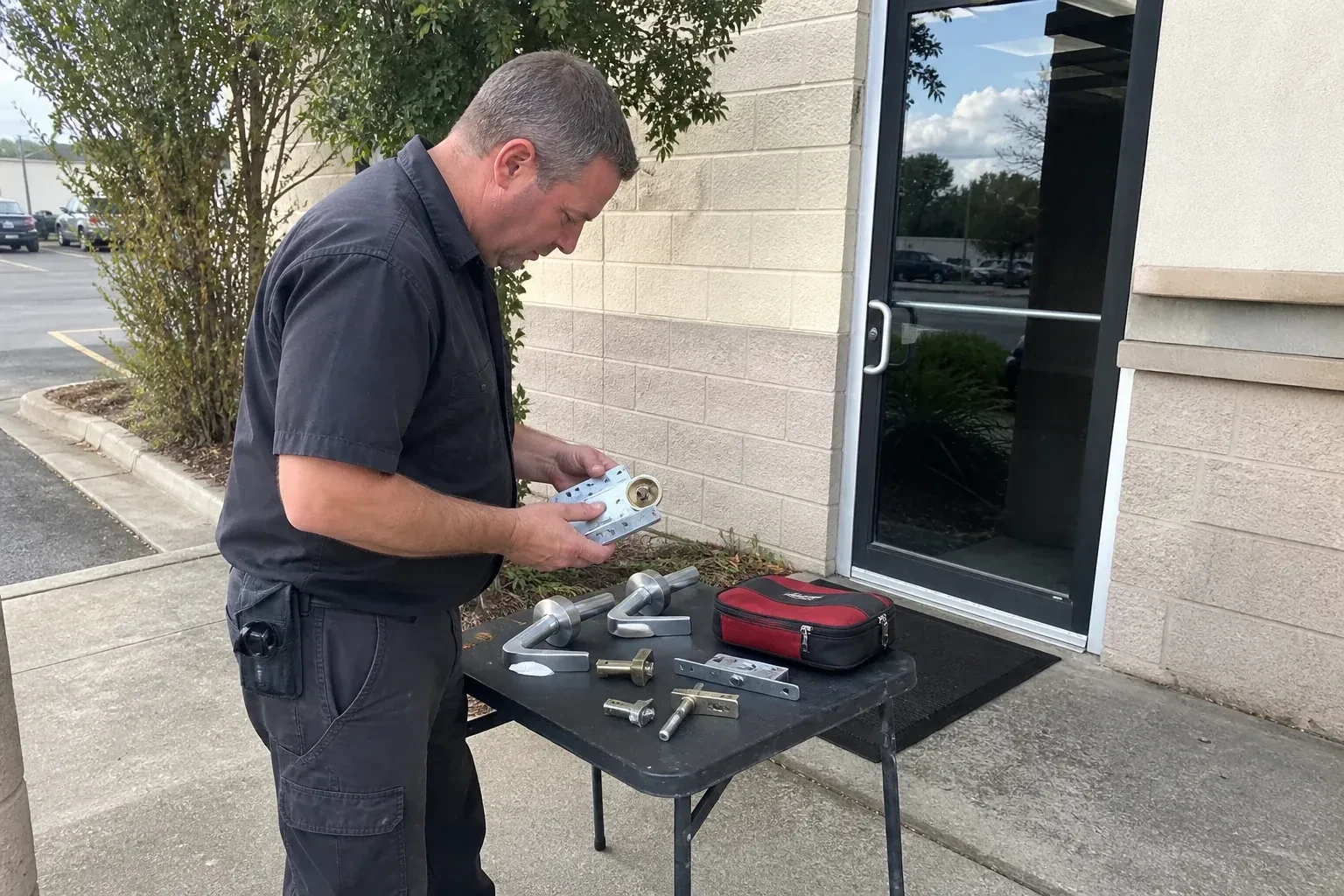
On a commercial door the lock is rarely alone. A door contact feeds the alarm panel, a card reader drives an electric strike or a magnetic lock, and a monitoring company is watching for an opening outside business hours. A business lockout therefore starts with a conversation about those systems: who can disarm the alarm, whether the monitoring station should be told to expect an entry, and whether the electrified hardware has a mechanical override. Handling that first means the door opens without a patrol being dispatched, the access system is left working as designed, and the reader can be reset once someone is inside.
How the visit goesIt is ten to nine, three staff are on the sidewalk with their coffees, and the key that has opened the glass front door for six years will not turn. The cylinder feels gritty, the door is locked, and the first customer is already parking.
Business Lockout Service
How the visit goes


Who is asking, and for which company
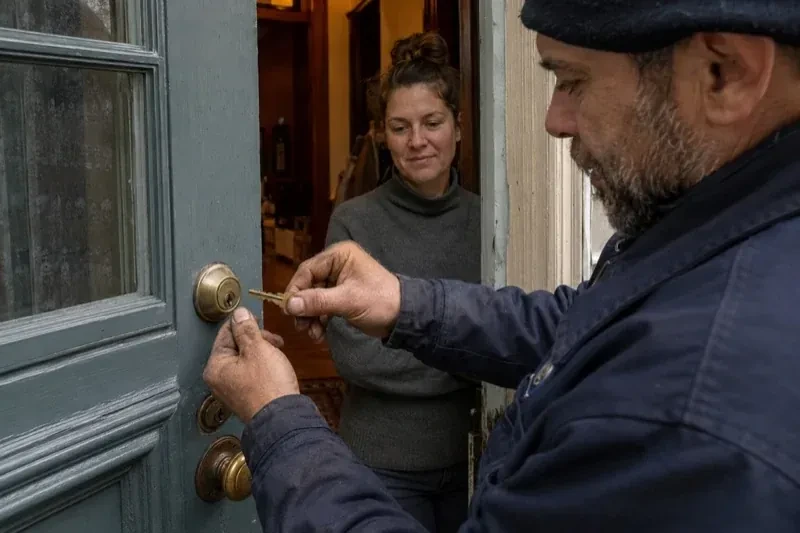
The first check is about authority to act for the business. An owner or director shows photo identification and a document that ties them to the premises, such as the lease, the business registration or a supplier invoice addressed to the unit. A manager or staff member is confirmed by a call to the owner, the head office or the property manager, using a number the locksmith can look up rather than one written on a scrap of paper. A landlord or their agent shows the lease clause or written instruction behind the request. When the paperwork is behind the locked door, the check is completed inside before the locksmith leaves.
Getting past a dead reader or strike
Electrified doors are opened by restoring what they lost rather than defeating them. The locksmith checks the power supply, breaker and battery backup for the controller, and a dead strike or reader often comes back with a fresh fuse or a charged battery. Where the hardware has a mechanical override, that cylinder is picked or decoded like any other. A magnetic lock that stays energised is released through its own controller or by the access-control provider remotely, never by cutting a wire, so fail-safe and fail-secure behaviour stay as the system designer intended. Once inside, credentials are re-enrolled, schedules confirmed and the alarm monitoring company told the entry is complete.
Ready for the rest of the winter
A storefront cylinder that froze is handed back dried, cleaned of salt and dressed with a dry lubricant that sheds moisture instead of trapping it. A tube of lock de-icer for the opening manager's coat pocket and a keyhole cover on the most exposed door are small habits that carry a business through a season of freeze and thaw. The closer is adjusted for cold weather so the door still latches when the fluid thickens, and the threshold is checked for the ice ridge that forms where slush is tracked in. If the same door freezes every year, a weather-shielded cylinder or a small vestibule heater is worth a conversation.
Business Lockout Service
In the van
Broken key extractors
Commercial pick and tension tools
Storefront deadlock and deadlatch bodies
Cylinder decoder and plug spinner
Strikes, pivot shims and closer adjustment tools

Business Lockout Service
What affects the quote
Upgrades you choose while the locksmith is there
Some businesses use the visit to move to a heavier storefront deadlock, a restricted keyway, interchangeable cores, a lockbox for keyholders or a reinforced strike. None of it is needed to get you open; each is priced as its own option.
Standard or high-security cylinder
Restricted keyways, security pins and patented cylinders take longer to open and cost more to replace, and their keys are cut from system records rather than copied at a counter.
Door, pivot and closer adjustment
When the lockout was really a dropped door or a tired closer, lifting the door, adjusting pivots or a continuous hinge, moving the strike and resetting the closer are quoted as their own item beside the opening.
What to have ready
- Does the door use a card reader, keypad or intercom, and is it showing any lights?
- Is anyone able to reach the owner, head office or property manager to confirm the request?
- Has the door been dragging, scraping the threshold or failing to latch at closing recently?
Business Lockout Service: questions
QuestionsDo you work with our alarm company and access-control provider?
Yes, and it makes the visit smoother. The alarm station is told an entry is expected and the authorised person handles the disarm and password. For access control, the provider can often confirm the controller's status, unlock a magnetic lock remotely, or re-enrol fobs once you are inside, while the locksmith handles the mechanical side and the override cylinder. Nobody's wiring is cut; each party does the part it is set up to do.
I am an employee, not the owner. Can you still open the door for me?
Yes, with the owner or a manager in the loop. Tell the locksmith who can confirm you work there and how to reach them. A call to the business owner, the regional manager or the property manager, ideally on a number that can be looked up rather than one you supply, settles it. Staff on an opening shift arrange this on the phone before the locksmith arrives so nothing waits at the door.
We need to open for customers. How do you sequence the visit?
Entry comes first and repairs second. Once authority is confirmed the door is opened, staff go in and start their routine, and the locksmith turns to the cause: extracting a broken key, rekeying for a lost one, re-springing a deadlatch or lifting a dropped door. Anything that can wait for a quieter hour, such as rekeying interior doors, is offered as a return visit so the shop floor is not blocked while it trades.
Related services
- Broken Key ExtractionOvernight the deadbolt froze, and this morning the key would only turn partway.
- Break-In Damage Lock RepairThe patio slider is sitting crooked on its track.
- Seized & Jammed Lock OpeningThe shop's lever handle goes down as usual, but the latch inside the mortise case never pulls back.