Commercial · Centre Wellington
Panic & Exit Hardware in Centre Wellington
Two doors used to swing as a pair at the community hall entrance, but one leaf has started closing before the other, catching the astragal and leaving a gap wide enough to worry the caretaker.
In plain words
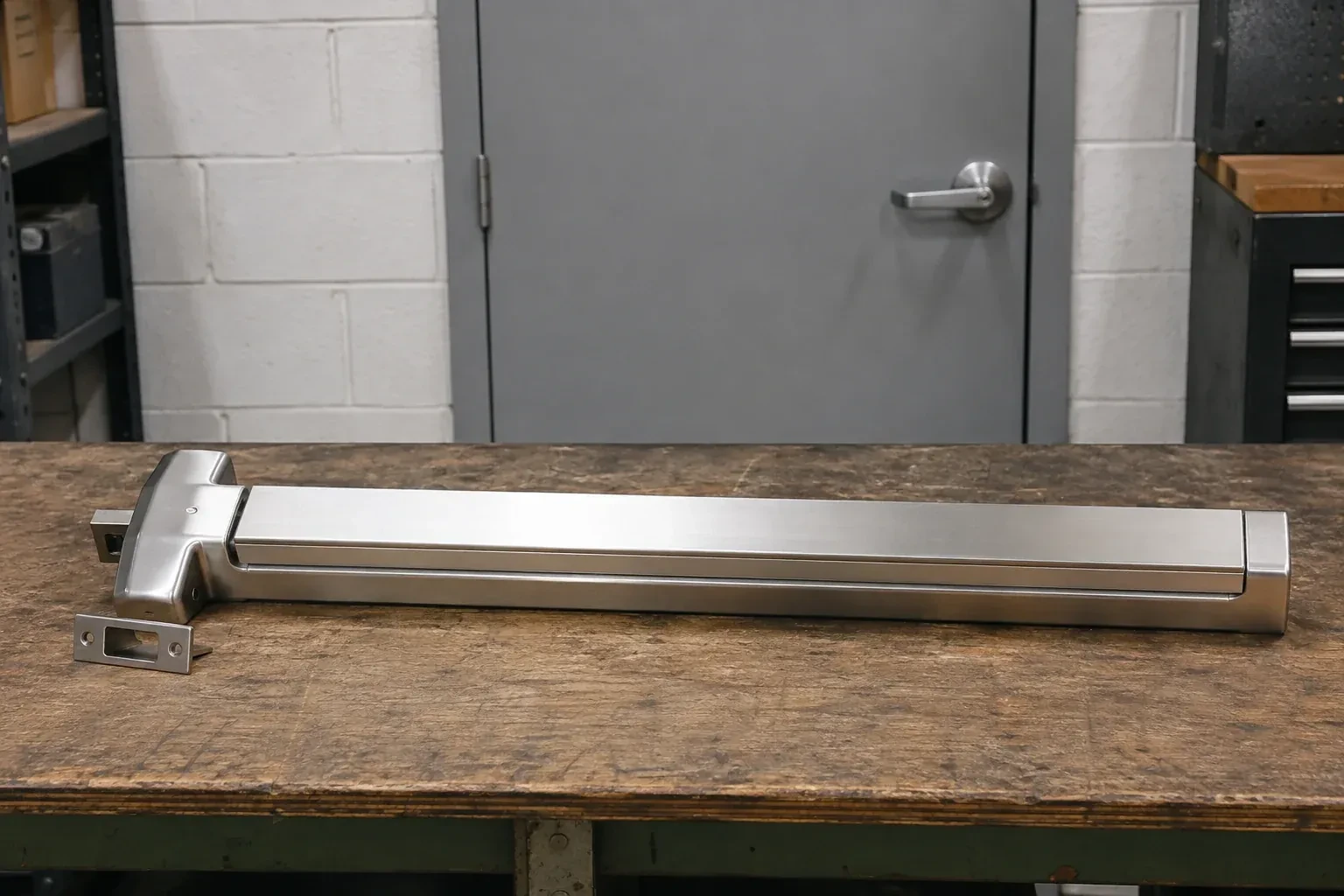
Panic and exit hardware installation fits a commercial door with a device that releases the latch the moment someone pushes on it from the inside, so the room's occupants are never asked to find a key to leave. The locksmith works from the room's occupancy and the door's fire rating first, then chooses a rim, mortise or vertical-rod device to suit the opening, pairs it with outside trim that still controls entry, and tests the release force and the latch before handing the door back. Any electrified addition, such as an alarm or a link to access control, is fitted once that basic function is confirmed.
How the visit goesA padlock went on the stockroom's back door years ago for security and nobody has thought about it since, until the walkthrough this week pointed out that the same door is the room's only other way out.
Panic & Exit Hardware
How the visit goes


What the access-control side of the door needs
When a card reader, keypad or intercom is part of the plan, the assessment includes a conversation about the exit side of the same door: does the reader need a request-to-exit signal so the panel knows someone left rather than forced the door, and does the door need electric latch retraction so it can be released remotely without ever compromising the crossbar's push-to-exit function. These questions are answered before the device is ordered, because retrofitting an electrified function onto hardware chosen without it in mind rarely goes cleanly.
Adding electrified functions
Where the plan includes access control or an alarm, the wiring is run and terminated to the device without touching its mechanical exit function: a request-to-exit switch reports that the pushpad or crossbar was actuated, electric latch retraction lets an authorized signal release the latch for entry, and an alarm module sounds locally when the crossbar is used. On a fire-rated opening, electric latch retraction is arranged to relatch automatically the instant a fire-alarm signal comes in, since a fire door has to keep its active latch and cannot rely on a mechanical dogging function to do that.
A door that opens under one motion, every time
What the space has afterward is straightforward: anyone inside can leave through that door with a single push on the crossbar or touchpad, no key, no second step, no need to remember which way a lock turns. Staff can be shown the motion once and it stays intuitive, because that is exactly what the hardware is built to do. Outside, entry still works the way it was set up to, through the trim chosen for that door, entirely separate from the exit function inside.
Panic & Exit Hardware
In the van
Dogging key or keyed cylinder
Through-fixings and mounting hardware
Force gauge
Astragal and mullion hardware
Signage and labels

Panic & Exit Hardware
What affects the quote
Electrified functions added
A request-to-exit switch or electric latch retraction adds wiring, a power source and coordination with the building's other systems, while a standalone alarm module can run on its own battery; each is priced alongside the mechanical installation itself.
Weatherproofing for an exterior opening
An exterior device, strike and trim built to handle temperature swings and moisture cost more as hardware than an equivalent interior-only set, and the quote reflects that difference in the parts themselves.
Access-control integration
Where the door ties into an existing access-control panel, coordinating the exit hardware's signals with that system takes planning with whoever maintains it, which the quote accounts for separately from the device itself.
What to have ready
- Is this for new construction, a renovation, or an existing building?
- Is access control or an alarm system planned for any of these doors?
- Does any door already have a hasp, padlock or extra deadbolt fitted?
Panic & Exit Hardware: questions
QuestionsHow is occupant load actually counted for this decision?
Occupant load is calculated from the floor area and the intended use of the room, using published factors for that occupancy type, rather than a headcount taken on a busy night. A building official or a locksmith familiar with the calculation can work through it for a specific room, and the result is what decides whether the exit doors serving that room need a releasing device.
When does a door actually need this hardware rather than a regular lock?
It comes down to occupancy and occupant load rather than preference. Rooms used for assembly, such as banquet halls, places of worship or gyms, and doors serving a stairway in a busier building, are where this hardware becomes the standard choice instead of a keyed lock on the exit side. A fire inspector or building official is the practical way to confirm whether a specific room has crossed that line.
What is dogging, and can every door have it?
Dogging holds the device's latch retracted so the door works as a simple push-pull for a period, useful during business hours on a busy entrance. It is not available on fire-rated openings, because a fire door must keep an active latch at all times; on those doors, electric latch retraction achieves a similar push-pull convenience without ever leaving the latch mechanically held back.
Related services
- Master Key System DesignThe office key ring has become the org chart.
- Access Control InstallationSomething went missing from the storeroom over a weekend, and when you ask who was in the building, the honest answer is anyone with a key.
- Commercial-Grade Lock ReplacementA new tenant moved into the unit next door, and the property manager just found three different cylinders on three doors, none of them cut to the same key.